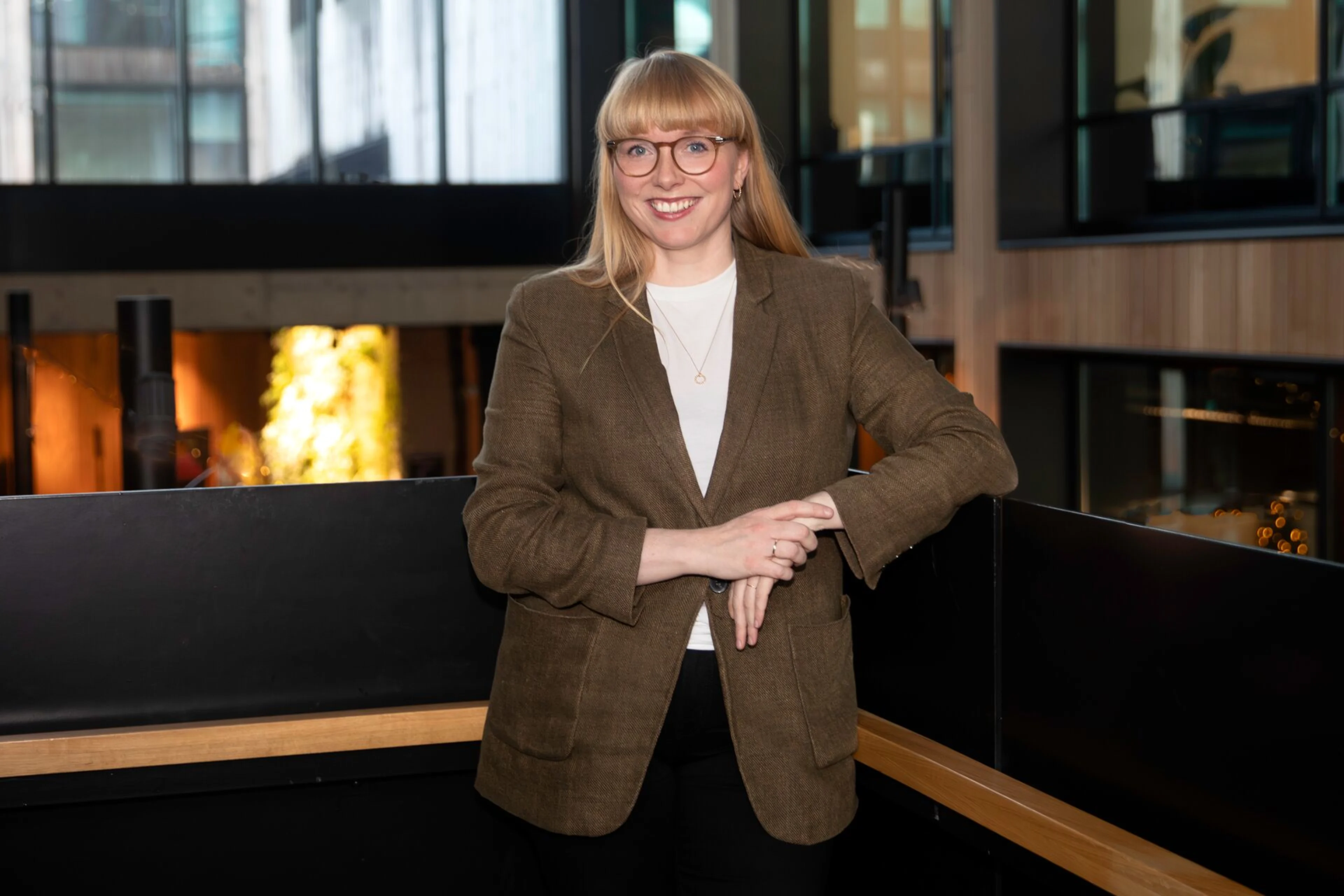
Ragna Margrét Guðmundsdóttir
Beauty is a Practical Force
Perhaps you've noticed beautiful small wooden houses, made of light-colored wood with large windows, scattered around the capital area, marked with the curious word Pikkoló? In fact, you might have visited one to pick up a box of delicious Icelandic vegetables, juicy Spanish fruits, or a quick meal kit from Eldum rétt. When you step inside, the house sighs pleasurably and an attractive cloud of cool vapor shoots out from the compartments housing the food products. Aaaah.
These are refrigerated Pikkoló stations run by Ragna Margrét Guðmundsdóttir and Kristbjörg María Guðmundsdóttir, founders of the company Pikkoló, which they launched in 2020 with the aim of breathing new life into the corner store concept – in a more modern and sustainable version. Pikkoló's main goal is to help people access diverse and fresh food in their local environment in a simple, affordable, and environmentally friendly way.
With Entrepreneurial Blood
When Ragna Margrét returned to Iceland after her studies in 2016, she founded the design studio M/STUDIO with Kristbjörg María, who is a trained industrial designer, and that's where the seed that eventually became Pikkoló was planted.
"I always knew I should do something creative," she says. "There's some entrepreneurial blood in me – for as long as I can remember, I've wanted to create something of my own and have always felt a strong need to do things myself and create something new."
Ragna Margrét says that the idea for Pikkoló was born in the spring of 2019 when their design studio was asked to give a presentation about the future of retail in downtown Reykjavík for Athafnaborgin okkar (Our City of Enterprise) on behalf of the City of Reykjavík.
The inspiration came from the realization that the small corner store has, unfortunately, largely disappeared from contemporary life. In recent years, stores have grown larger and moved farther away from people into bigger premises on the outskirts of the city. The positive effects have been lower prices and a significantly increased selection. On the other hand, people now need to travel farther to reach a grocery store and are therefore more dependent on private cars. Ragna Margrét and Kristbjörg want to reverse this trend with the help of Pikkoló and digital development in the food market. Now people can shop directly from selected small producers online and choose to pick up their goods at the nearest Pikkoló station at their convenience.
"Kristbjörg María had a subscription with Eldum rétt but I didn't at the time when the idea was born," says Ragna Margrét. "I lived in an apartment building and found it uncomfortable to leave the Eldum Rétt box with food sitting outside my door for long periods. So we started thinking about how this could be done differently, as there were probably others in my situation."
"You're always looking for ways to finance your project"
How did getting Pikkoló started go? Did you have easy access to funding?
"In the early stages of companies, it's often very difficult to get funding," says Ragna Margrét. "Statistics show that it's especially challenging for all-female teams. It's difficult when everything is still at the idea stage but becomes easier as the idea takes shape."
"However, we've been very lucky and got a yes at our first meeting with an investor who was actually a woman and is our angel investor today. We will always be grateful to her for believing in the project so early in the process."
"We've also been diligent in applying for various grants. Most recently, we received Sproti and Vöxtur grants from the Technology Development Fund. This has been tremendously important in getting Pikkoló to where it is today. BYKO has also strongly supported us with environmentally friendly materials for the stations."
How do you feel that it's harder for women than men to get funding?
"We haven't experienced much of that ourselves, and I think this is changing very rapidly now. Previously, it was mostly men who controlled the capital. These were perhaps homogeneous teams that had difficulty understanding the problems or opportunities that women brought to the table."
"Now we see that there has been significant progress in these matters in recent years. My feeling is that the gender balance is evening out, and consequently, more women are in positions that control capital and can perhaps better relate to the problems women are trying to solve." The projects of women and men are often very different, according to Ragna Margrét.
"Women are often tackling societal problems that can be challenging to generate quick profits from and often need to look at value in a broader context and over a longer term. Naturally, it's harder to find investors for such projects," she says.
"However, I believe that a golden middle ground can be found in these matters: between social benefit and financial gain. But that's exactly what we're doing with Pikkoló, a solution that benefits the local community, supports innovation in the food market, and reduces traffic in the distribution of fresh food purchased online."
Beauty is a Practical Force
Ragna Margrét further points out that they have certainly often received rejections from investors, and some of the investors they spoke with in the early stages hesitated at the emphasis placed on beauty in the design of the service stations. One even asked: Why does this need to be so beautiful? But Ragna Margrét counters that the modern corner store absolutely must not be some soulless gray capsule on a street corner.
"We want this to be a positive experience in every way and for the Pikkoló stations to fit well into the local environment. That way, you feel good when you come to pick up your food. It matters."
The emphasis on beauty is therefore practical. Customers are more likely to remain loyal to Pikkoló if visiting is enjoyable. Beauty is a practical force.
Important to Show Perseverance and Keep Going
Ragna Margrét encourages other women to implement their ideas and not stop believing in them even when facing headwinds. Often it takes great patience and endurance, for example, in preparing endless grant applications – and it's never fun to get rejected by investors. But often it only takes one yes to get started – and then more yeses are likely to follow.
Today, there are five Pikkoló stations in operation in the capital area, with plans for significant expansion in the coming months.
Share article: